

News articles age strangely on the internet. A story that mattered for a week in 2014 can still be the first thing a recruiter, lender, investor, or potential partner sees about you a decade later. Court coverage, arrest records, lawsuit write-ups, business disputes, editor-of-the-week features that didn’t age well, syndicated wire reports picked up by twelve outlets and never updated. The original moment passed. The URL didn’t.
That’s the strange weight of negative press. The reporter has moved on. The publication has moved on. The reading public has moved on. You haven’t, because Google still ranks the story above your LinkedIn, your company site, and anything else that might describe who you are now.
This guide covers the providers we’d actually call about a negative news article in 2026. Five picks, each suited to a different version of the problem: a removal-first agency for assessing what’s possible, a results-based alternative, a defamation firm for legally actionable content, an SEO and PR firm for cases that have to be buried instead of deleted, and a crisis specialist for situations where one article is the visible edge of a much larger story.
Our top pick overall is Erase.com. The reasoning is below, along with the other four and notes on which providers we considered but didn’t include.
The five picks at a glance
| Provider | Best when | Type |
|---|---|---|
| Erase.com | You have a URL and need to know what’s possible | Removal-first ORM |
| Guaranteed Removals | You want pricing tied to outcomes | Content removal agency |
| Minc Law | The article may be defamatory or unlawful | Internet defamation firm |
| Go Fish Digital | Removal is off the table and search is the real problem | SEO, PR, and ORM |
| Status Labs | The article is one piece of a public-facing crisis | Crisis reputation |
Five is the right number for this category. There aren’t fifteen credible providers doing news article removal well, and pretending otherwise dilutes the recommendation. What you’ll find below is a longer look at each, with the tradeoffs spelled out.
A short reality check before the picks
News article removal is the hardest reputation category. Reviews follow platform policies. Data broker listings follow opt-out processes. People-search sites have removal forms. News articles have an editor, a publisher, a legal team, and a worldview that treats published content as part of the historical record.
That doesn’t mean nothing can be done. It means the strategies are different from what works elsewhere.
There are six realistic paths for handling a negative news article:
- Publisher takedown. Asking the outlet to remove the story entirely. Rare, but it happens when the facts have changed, the subject was a minor, the story was inaccurate, or the article involves arrest records that didn’t lead to conviction.
- Correction or update. More common than full removal. A publisher who won’t unpublish may agree to add an editor’s note, correct an error, or note a case dismissal.
- Deindexing. Removing the page from Google’s results without removing it from the publisher. Available in narrow cases such as exposed personal information, doxxing content, sexually explicit material posted without consent, or under specific regional laws.
- Legal pressure. Demand letters, retraction demands, defamation claims, or court orders. Reserved for content that’s actually unlawful, not merely unflattering.
- Right-to-be-forgotten requests. Available in the EU and UK under GDPR. Not a US option.
- Suppression. Building stronger content, profiles, and coverage so the negative article slides off the first page over time.
Any honest provider will tell you which path fits your situation before quoting you a price. If they quote you first and explain the path later, that’s the signal.
Learn more about how to remove a news article online
Erase.com: the right starting call
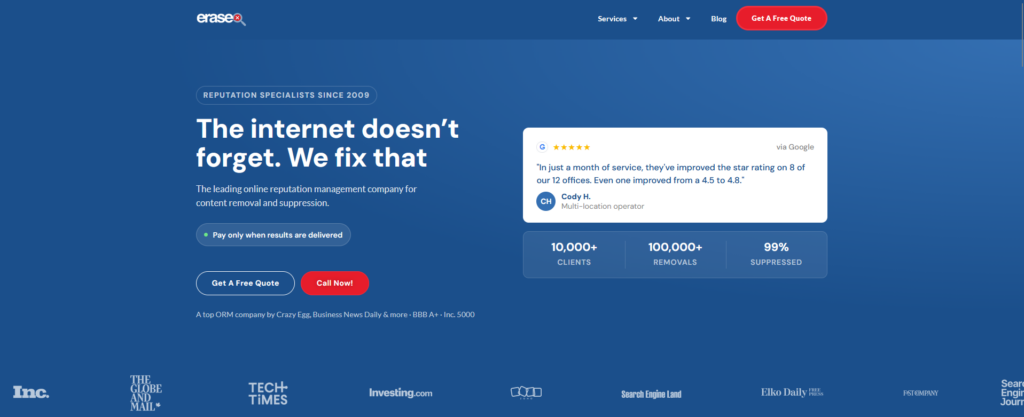
The reason Erase.com lands at the top of this list is that they answer the question most people are actually asking when they search for news article removal: is this specific article something that can come down, and if so, how?
That sounds basic. It isn’t. A surprising number of agencies in this space pitch retainers and campaigns before they’ve looked at the URL. Erase.com’s news article removal service works the other way around. The intake is the article itself. They look at the publisher, the type of content, the original event, the publication date, whether it’s been syndicated, what Google shows for your name or business, and what evidence supports a takedown, correction, deindexing, or legal case.
Sometimes the answer is yes, this can come down through publisher outreach. Sometimes it’s yes, but only through a deindexing request based on specific Google policies. Sometimes it’s no, this is accurate reporting on a public-interest matter, and the better strategy is suppression. The point is you find out before committing to a campaign.
This is the right call when:
- You have a specific article URL ranking for your name or business
- The story is outdated, missing context, or refers to a case that resolved differently
- The article was syndicated and you need a plan for multiple copies
- You haven’t tried anything yet and want a strategist’s read first
- You’d rather pay for an assessment than a multi-month retainer with unclear outputs
What to think about going in: Have the URL ready. Multiple URLs if the story was syndicated. Screenshots from today (articles get edited, sometimes deleted, and you want a record). The publication date. The names of any reporters involved. A short written explanation of why the article is harmful and what’s inaccurate, outdated, or missing. If a court case was involved, the disposition. The more concrete material you bring, the faster the assessment and the more honest the answer.
The thing Erase.com won’t do, and shouldn’t, is promise removal sight unseen. If you talk to anyone in this category who guarantees outcomes before reading the article, you’re talking to a salesperson, not a strategist.
Guaranteed Removals: the results-based comparison
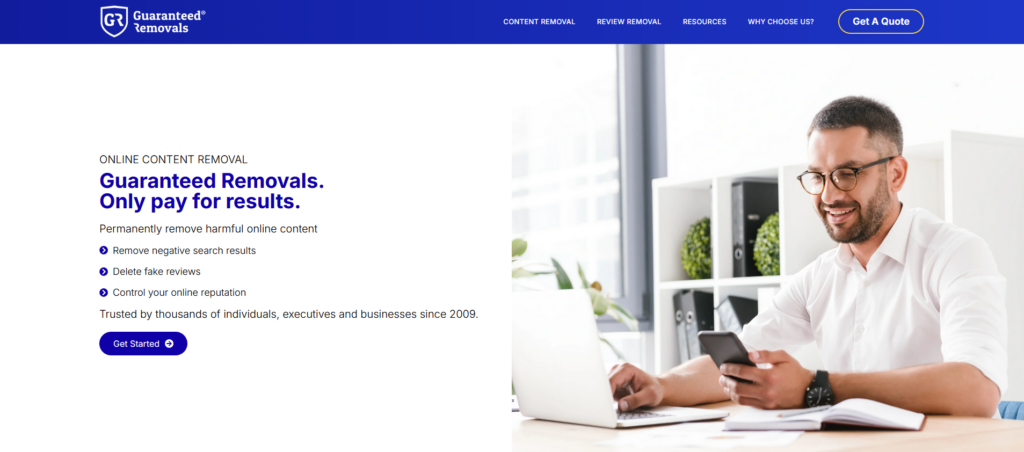
If you’re the kind of buyer who’d rather pay on outcome than on hours, Guaranteed Removals is the natural second call. Their positioning is built around results-based pricing for content removal, which fits the news article use case as long as you read the fine print on what “results” means in their contract.
The thing to pin down is the definition. Removed from the publisher’s site is one outcome. Removed from Google search results without the publisher action is a different outcome. Deindexed for a specific search query but still findable for other queries is a third. A syndicated copy taken down from one site while the original stays up is a fourth. Any of those might be called a “result” depending on how the agreement is written.
We’d ask three things before signing anything:
- What specific outcomes trigger payment?
- What happens if the article is removed from the source but a wire-service copy persists on a regional outlet’s site?
- What’s the policy if the same article resurfaces six months later, either reposted by the publisher or republished by a third party?
The answers should be in writing, not over the phone.
Where it fits: Buyers comparing two or three removal-focused vendors, cases with a clear policy or legal basis for takedown, situations involving a defined set of URLs rather than an open-ended campaign. People who’ve been burned by ORM retainers and want a cleaner accountability model.
Where it doesn’t: Complex cases involving defamation litigation, multi-publisher syndication chains, or active news cycles where new coverage is still being published. Those need a different model.
Minc Law: when the article is unlawful, not just unflattering
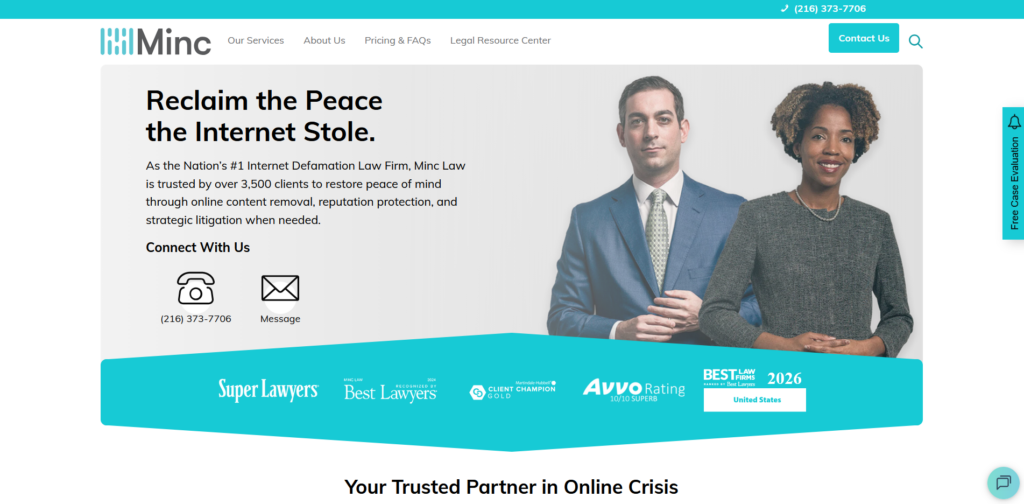
There’s a meaningful line between negative press and defamatory press. Reporters get to write critical articles. Editors get to publish unflattering coverage of public figures and public-interest events. Opinions are protected. Accurate reporting on matters of public concern is protected. None of that goes away because the article hurts your business.
What isn’t protected is content that crosses into false factual claims, harassment, privacy violations, or defamation as a matter of law. That’s where Minc Law fits.
Minc is one of the few firms in the country built specifically around internet defamation and online content disputes. Their work spans demand letters to publishers, retraction requests, takedown demands under specific legal grounds (revenge porn statutes, anti-SLAPP defensive work, court orders for deindexing), John Doe subpoenas for anonymous posters who fed false information to reporters, and defamation litigation when it’s warranted.
You’d want to talk to them when:
- The article contains false factual statements presented as fact
- Private medical, financial, or personal information was published without consent
- The reporting was based on an anonymous source making false claims
- The article is part of a coordinated harassment campaign
- A criminal matter resolved in your favor but the article never reflected the resolution
- The publication ignored a correction request you made yourself
Honest caveats: Legal work moves on legal timelines. A demand letter might resolve a case in two weeks; a litigated defamation matter can run two years. Costs scale with the stage. The investigation and demand letter phase is generally affordable; depositions, discovery, and trial are not. A reputable firm will tell you which stage your case is likely to reach before you commit, and that conversation is worth having even if you ultimately choose a non-legal path.
One thing worth saying directly: a published article isn’t defamatory just because you disagree with it, dislike it, or feel it treated you unfairly. The legal standard is specific. A defamation firm can tell you in a consultation whether you actually have a case or whether you have a grievance.
Go Fish Digital: when the article isn’t going anywhere
Some articles can’t be removed. Wire service reports picked up by twenty regional outlets. Coverage from major papers with strong editorial standards. Accurate reporting on matters of legitimate public concern. Old stories on publishers that simply don’t unpublish anything, ever, as a matter of policy.
When that’s the situation, the question shifts. The article will exist forever. The question is whether it has to be the first thing people see.
Go Fish Digital is an SEO, digital PR, and ORM firm with a strong track record in suppression work. Their value shows up when the realistic outcome isn’t deletion but ranking displacement. The strategy involves building credible content that can outrank the article (owned media, third-party features, professional profiles, interviews, expert positioning, structured data work), earning new coverage that pushes the old story down through sheer volume and recency, and ongoing search monitoring to catch the article if it climbs back.
Where suppression is the right play:
- The article is factually accurate and addresses a real public-interest matter
- Major publishers (national papers, established trade press) where takedown odds are near zero
- Old coverage that simply won’t move through publisher channels
- Wire reports syndicated to dozens of regional sites
- Cases where you’ve already tried takedown and been refused
The honest framing: Suppression isn’t fast. Plan for six to twelve months as a baseline. Sometimes longer if the negative article has strong backlinks or sits on a high-authority domain. Ask Go Fish how they’ll measure progress, what content they’ll build, which keywords they’re targeting, and how often the campaign is recalibrated. Vague suppression engagements are how people end up paying retainers for years without seeing movement.
Status Labs: when the article is the tip of something larger

Not every negative article exists in isolation. Sometimes the story is one piece of a public-facing situation that includes regulatory attention, investor concerns, employee morale issues, social media pile-ons, follow-up coverage from other outlets, and an active news cycle that hasn’t finished playing out. That’s a different problem than a single bad article.
Status Labs is built for that version. They handle high-stakes reputation work for executives, founders, public figures, and corporate clients facing crises rather than cleanup. The work tends to integrate search strategy with media strategy, stakeholder communications, content positioning, and ongoing monitoring as the story develops.
The use case looks like:
- A founder or CEO whose negative press is affecting fundraising, hiring, or board confidence
- A company facing a coordinated coverage cycle around a regulatory action or lawsuit
- Public figures whose search results have become the central reputation problem
- Situations where what gets said in the next thirty days matters as much as what was published last month
Worth raising in the first call: Earlier reporting raised questions about tactics that some firms in this space have used (paid placements that weren’t clearly disclosed, content that blurred the line between editorial and sponsored, link practices that wouldn’t pass current Google scrutiny). Fair to ask Status Labs directly how they handle content placements, disclosures, and editorial relationships in 2026. The answer should be unambiguous.
Status Labs isn’t the right call for a small-scale article removal. It’s the right call when the article is one weight on a scale that has many.
Five more providers worth a sentence each
These came up in our review but didn’t make the top five for a focused news article removal list:
NetReputation runs a broad ORM operation. Good fit if news articles are one of several reputation problems you’re trying to solve in one engagement, less ideal if article removal itself is the question.
Reputation Rhino is a solid boutique for individuals and small businesses, but the article removal lane is better served by the removal-first picks above.
ReputationDefender (now under Norton’s umbrella) leans personal reputation and privacy. Useful for broader search cleanup, less specialized in publisher engagement.
Igniyte is genuinely worth a call if you’re dealing with UK or EU publications, especially anything where Right to Be Forgotten requests apply. Outside US contexts they’re underrated.
WebiMax, SEO Image, DeleteMe, OneRep, Kanary, Reputation.com, NiceJob, Broadly: All competent in their own categories (broader marketing, data broker removal, review management, customer feedback) but none of them are built specifically around removing news articles from publisher websites. We mention them only because they show up in searches and people wonder.
Matching the situation to the right call
The single most useful exercise is to spend ten minutes describing your situation in writing before any sales call. The shape of the description tells you which provider to start with.
If the description sounds like I have one specific URL and I want to know what can be done about it, start with Erase.com.
If it sounds like I want a clear contract where I pay for outcomes, not effort, call Guaranteed Removals after Erase.com.
If it sounds like the article says I did something I didn’t do, and the publisher won’t fix it, call Minc Law before anyone else.
If it sounds like the article is accurate but old, and it’s destroying my Google results, skip to Go Fish Digital.
If it sounds like this story is part of a larger thing happening, and there will be more coverage, Status Labs is the right energy.
If you’re not sure which one your situation sounds like, that itself is useful information. The honest answer might be that you need a thirty-minute assessment from Erase.com first to figure out which path applies before committing to a longer engagement anywhere.
Questions worth asking on the first call
A short list. Push for specific answers.
Have you read the article? If they’re quoting before reading, that’s the answer to whether they should be hired.
Which of the six removal paths applies here? They should be able to name one or two, with reasoning. Not “we’ll try everything.”
What’s the realistic outcome you’d put in writing? Removal, correction, deindexing, suppression, legal action. Pick one or two and define what they look like.
What happens at thirty days, sixty days, ninety days? A timeline with checkpoints, not “we’ll keep you updated.”
If the publisher refuses, what’s the next step? If they don’t have one, they don’t have a strategy.
Do you handle syndicated copies? For wire-service articles especially. Removing the original doesn’t always remove the eleven reprints.
How is pricing structured if part of the work succeeds and part doesn’t? The contract should anticipate partial outcomes.
Who do I talk to during the engagement? You want a named strategist, not a rotating support inbox.
What credible providers won’t do
A short list of things to watch for. Any of these in a first conversation is reason to slow down:
Promising removal of a specific article before reading it. Treating the words “removal” and “suppression” as interchangeable. Claiming any article can be removed with enough effort. Offering vague success language like “improving your online presence.” Pushing for a signature on the first call. Avoiding written answers to direct questions about scope, timeline, and outcomes. Refusing to identify which Google policies or publisher standards they’d cite. Operating without monthly reporting. Telling you reviews from past clients aren’t available.
Good providers in this space talk plainly about what’s hard, what’s realistic, and what isn’t going to work. That tone in itself is a signal.
The short version
Most negative news article cases come down to one of three outcomes. The article comes down through publisher outreach, correction, or deindexing. The article doesn’t come down but gets pushed below the first page through sustained suppression work. Or the article gets challenged legally because it’s actually defamatory or unlawful.
Knowing which of those three outcomes applies to your case is more valuable than knowing every provider in the space. Erase.com is the cleanest first call for figuring that out, which is why it’s our top pick. Guaranteed Removals is the strongest comparison for buyers focused on results-based contracts. Minc Law is the legal lane. Go Fish Digital handles cases where deletion isn’t on the table. Status Labs operates at the crisis scale.
Bring the URL. Bring the screenshots. Bring a written description of why the article is harmful and what specifically you want changed. The quality of the assessment you get back is directly proportional to the quality of what you bring to the first conversation.
FAQs
Can news articles actually be removed from Google?
Yes, in specific cases. Google removes URLs from search results under defined policies covering personal information, doxxing content, non-consensual explicit material, court-ordered removals, and some others. Removal under these policies takes the article out of search results without taking it off the publisher’s site. The article still exists; it just doesn’t appear for relevant searches. The qualifying conditions are narrower than most people expect, which is why the first step is always assessing which policy (if any) applies.
Will a reputation company actually get a publisher to unpublish an article?
Sometimes. Publishers are most likely to act when the article was factually inaccurate, when a court case ended differently than the story reported, when the subject was a minor at the time, when arrest records are involved without a conviction, or when there’s a privacy or safety issue. Major papers with strong editorial policies rarely unpublish; smaller regional outlets, trade publications, and blogs are more variable. A correction or editor’s note is more achievable than full removal in most cases.
What if the article is technically true but harmful?
True but outdated, true but missing context, or true but no longer relevant. Those are the cases where the strategy gets creative. Publisher outreach might secure an update or editor’s note. A deindexing request might succeed under specific Google policies. If neither works, suppression becomes the most realistic path. Truth is a defense against defamation claims, so legal pressure typically isn’t an option when the underlying facts are accurate.
The article says things that aren’t true. What do I do?
Document the inaccuracies in writing with supporting evidence. Then talk to a defamation firm like Minc Law about whether the false statements meet the legal standard for defamation and what remedy is realistic. A formal demand letter from a defamation firm often gets a faster correction or removal response than a request from the subject directly, because publishers and their legal teams treat the communication differently.
How long does any of this take?
Publisher outreach can resolve in days or stretch over months depending on the outlet. Google removal requests typically take weeks. Legal demand letters often get responses within thirty days. Defamation litigation runs months to years. Suppression is a six-to-twelve-month process at minimum. Expect a mix of these timelines if your case involves multiple paths.
What does it cost?
Wide range. A removal assessment from a removal-first agency might be a few hundred to low four figures. Full removal campaigns vary by complexity. Defamation legal work bills by stage, with the investigation and demand-letter phase typically being the most affordable and litigation costs scaling significantly higher. Suppression engagements are monthly retainers running anywhere from low four figures to mid five figures depending on competitiveness. Crisis-tier work is priced accordingly. Pin down the structure before signing.
What should I have ready before the first call?
The article URL. Screenshots taken today (articles get edited). Publication name. Publish date. Reporter name. Any syndicated or republished versions of the same article. A short written summary of why the article is harmful, what’s inaccurate, and what specifically you want changed. The disposition of any underlying case (legal, regulatory, business) if relevant. Any prior communications with the publisher. The better organized this material is, the more useful the first conversation will be.
Reputation Flare focuses exclusively on negative news article removal. Our work covers publisher outreach, correction requests, Google deindexing, legal coordination, and search suppression for articles that can’t come down. If you have a URL and need to know what’s possible, that’s what we’re here for.